
An Enigma of Worlds
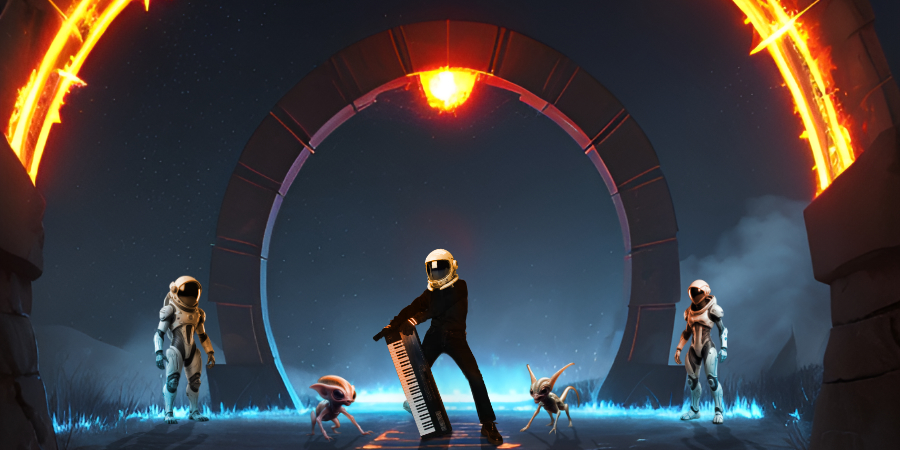
In the year 2011, George traveled through a portal to the year 1700 and created a world of enigma canons, which represent going forward and backward — simultaneously! This was a large contrapuntal project yielding 108 minutes of sophisticated counterpoint.
This musical world consists of thirty Palindrome Canons in a strict 18th century counterpoint style and contains one palindrome canon in each key — plus six enharmonic keys.
Each musical landscape contains a motivic melody that is heard forwards and backwards simultaneously. While some consider palindrome canons little more than than an intellectual exercise demonstrating technical ingenuity, these works aim to pair that structural elegance with memorable ideas.
What is a Palindrome?
A palindrome is a word, phrase, number, sequence, or in this case, music that can be read the same way in either direction. A palindrome canon can also be referred to as an enigma canon or crab canon. By definition, it is a form of imitative counterpoint, but being that the imitation occurs backwards, it is difficult, if not impossible, to realize that it is imitative.
Performance Instruments
The Palindrome Canons were written for the piano, but any treble-clef instrument, such as guitar, woodwinds, brass, strings, etc., can play them. Performing these on certain instruments will require the canons to be arranged accordingly, as The Palindrome Canons have a wider range than that of a guitar and other treble-clef instruments.
Ordering the Palindromes
Much thought was put into how these enigmas would be ordered. After exploring several different ordering scenarios, such as cyclic forms (fifths or fourths), ascending chromatically and alternating between major and minor keys (of which neither worked ideally due to the enharmonic keys), it was decided that the best structural design was the order in which they were composed. The reasoning for this decision is that after a piece was composed, the subsequent piece's character and tempo was based on the previous piece's character and tempo, which yields the most natural and flowing sequence. Thus, the structure that was built is presented in the order that these landscapes were created.
Together, these thirty musical enigmas form a single journey through symmetry, counterpoint, and imagination — an exploration where intellectual design serves musical storytelling.
The Palindrome Canons
Thirty Landscapes In a World of Enigmas
- Palindrome Canon in D Minor
- Palindrome Canon in E Minor
- Palindrome Canon in A Minor
- Palindrome Canon in B Minor
- Palindrome Canon in F# Minor
- Palindrome Canon in C# Minor
- Palindrome Canon in G# Minor
- Palindrome Canon in D# Minor
- Palindrome Canon in A# Minor
- Palindrome Canon in G Minor
- Palindrome Canon in C Minor
- Palindrome Canon in F Minor
- Palindrome Canon in Bb Minor
- Palindrome Canon in Eb Minor
- Palindrome Canon in Ab Minor
- Palindrome Canon in C Major
- Palindrome Canon in G Major
- Palindrome Canon in D Major
- Palindrome Canon in A Major
- Palindrome Canon in E Major
- Palindrome Canon in B Major
- Palindrome Canon in F# Major
- Palindrome Canon in C# Major
- Palindrome Canon in Ab Major
- Palindrome Canon in Eb Major
- Palindrome Canon in Bb Major
- Palindrome Canon in F Major
- Palindrome Canon in Db Major
- Palindrome Canon in Gb Major
- Palindrome Canon in Cb Major

"I have always been fascinated with symmetry and very passionate about counterpoint, so composing these palindromes was a great and very intellectually stimulating way for me to combine the two." - George Bellas
- The Palindrome Canons
- Composed by George Bellas
- Published ℗ Bellas Tune Factory, BMI
- Copyright © George Bellas. All Rights Reserved.
